Plantation Shutters

Lawrence Plantation Shutters

Fitted panels for openings that never repeat

Call (317) 999-5154Get Free Quote
Quick Answer

The questions below deal with specification rather than sales. Sizing, mount type, material choice and operation. Get those right and the aesthetic decisions take care of themselves.

  • Service: Plantation Shutters for Lawrence homeowners
  • Service area: Lawrence, IN and surrounding areas
  • Realistic sequence: appointment for the measure, a written specification, then fabrication of two to five weeks, then install. None of it needs rushing, and pushing the factory is where mistakes on custom sizes come from.
  • Insured and bonded
  • Serving Lawrence, IN since 2008
Plantation Shutters Services

Expert Plantation Shutters for Lawrence Homes

Shutters are the one interior treatment that reads as part of the building, and Lawrence has the openings that reward it. The 1908 quarters at Fort Benjamin Harrison give the deepest inside mount reveals anywhere in the city, brick openings with substantial wood jambs, and eighteen officers' homes on Lawton Loop West Drive were sized by rank so no two window schedules match. At the other end of the city, the tight 1998 to 2005 plats of Lawrence Lakes and Lawrence Woods give you square openings that repeat, which is where a shutter's crisp lines look their best without any fight from the building.

A shutter is a rigid panel inside a rigid frame, and rigid things dislike movement. Lawrence has 7,137 units built before 1970 and a median build year of 1992, so out of square openings are the default here rather than the exception. Where an opening is off by more than about a quarter inch we fit a deco or Z-frame to hide the discrepancy, and that frame is visible. Shutters also don't retract. A stile and a divider rail stay in your sightline all day, and with the louvers open you're still looking through a grid. Nationally they run about $175 to $800 per window.

When to Call

Signs You Need Plantation Shutters

If you notice any of these in your Lawrence home, it is worth booking a measure. None of it is urgent, and none of it fixes itself either.

Blinds keep breaking on a window you use daily

Existing shutters were built for a previous owner

The sliding door still has vertical blinds that rattle

A sunroom has curtains that are always in the way

Arched or angled windows sit bare

Shutter whites in two rooms don't match each other

A west room glares onto the television every evening

Tall great room windows make blinds look undersized

A patio slider needs coverage without a track of fabric

Louvers drift open instead of holding position

Our Process

How Lawrence Window Treatments Handles Plantation Shutters

Every job follows the same five-step process. Transparent, thorough, and done right the first time.

1

Three widths, three heights

2

Mounting depth at four corners

3

Panel layout and swings drawn

4

Divider rail heights marked

5

Hinge count and magnets specified

Real Project Photos

Plantation Shutters in Lawrence

Photographs from real plantation shutters jobs completed by our crew in Lawrence and surrounding areas.
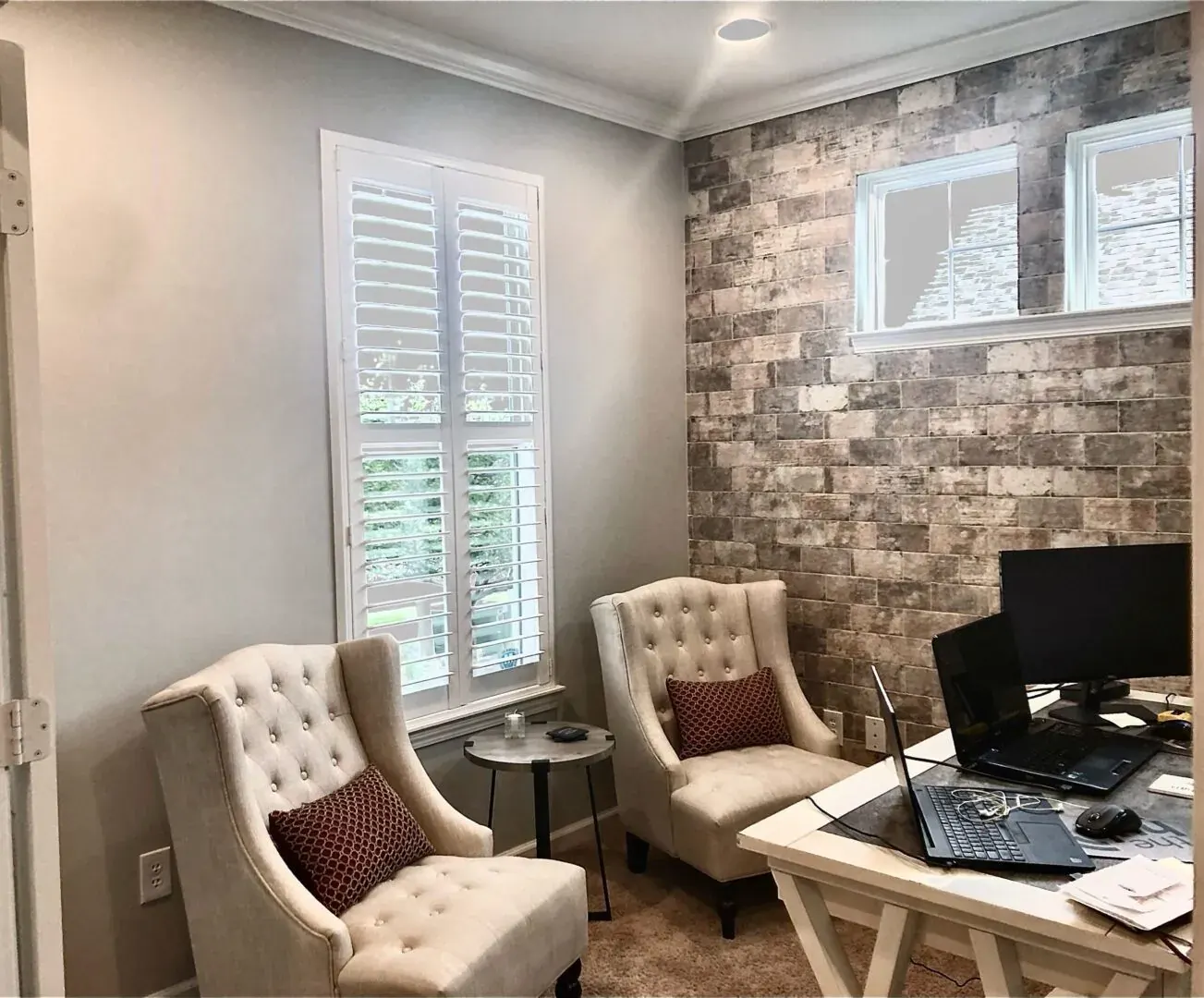
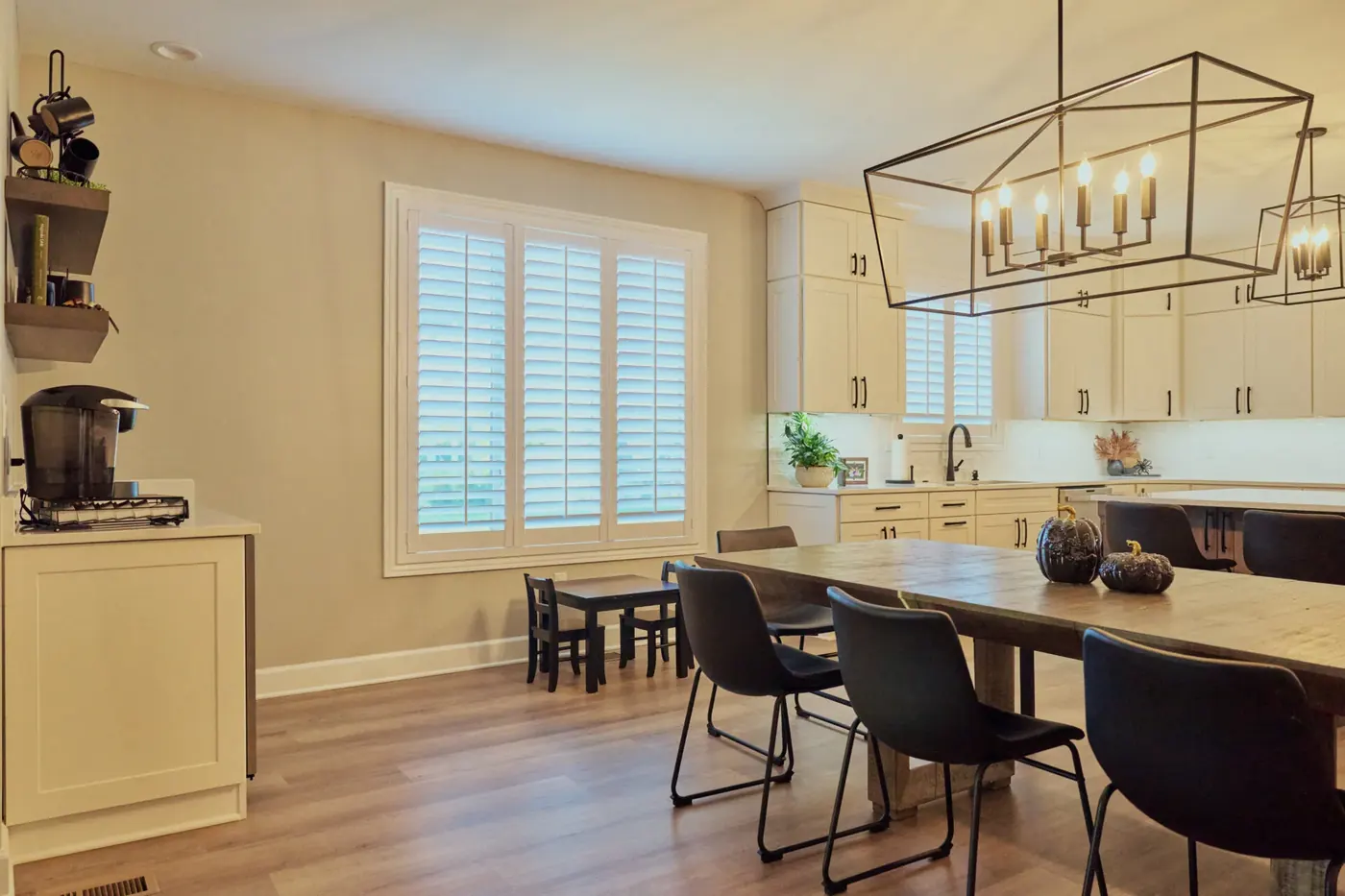
Custom shades measured and installed in LawrencePlantation shutters fitted to a Lawrence windowCellular shades in a Lawrence living room
Scope of Work

What Plantation Shutters Includes

Every Lawrence job is documented item by item. Here is what the crew covers.

Every opening measured three widths and three heights, then checked on the diagonal for square

Out-of-square openings quantified in sixteenths so the frame can be built to compensate

Mounting depth measured at all four corners to see whether an inside mount clears

Material specified per room, poly or composite anywhere humidity swings, hardwood only where it doesn't

Louver size chosen against the opening height and the trim, 2 1/2, 3 1/2 or 4 1/2 inch

Frame style selected per opening: L-frame, Z-frame or a deco frame with a wider face

Divider rails placed at a height that lines up across a room, not wherever the default falls

T-posts drawn on wide openings so panels stay a workable width and stay flat

Panel configuration laid out, how many panels, which way they swing, where they meet

Hinge finish and tilt rod style picked, hidden rod or a visible center rod

Bypass or bi-fold track specified where the opening is a patio slider rather than a window

Specialty shapes templated on site, arches, angles and circles included

Cut-outs marked for cranks, handles and anything else that lives inside the opening

Paint or stain matched to existing trim with a physical sample, never from a screen

Written contract with scope, dates and total price, as IC 24-5-11 requires on residential work over $150

Frames shimmed and fastened plumb so panels hang square and close without dragging

Louver tension set panel by panel so they hold position instead of drifting

Caulk and touch-up finished at the frame line so the shutter reads like part of the trim

Pricing

What Plantation Shutters Cost in Lawrence

Published national figures for interior shutters run roughly $175 to $800 per window. That's a national range for the category and it isn't a quote for a house in Lawrence, because shutter pricing follows the opening more closely than almost anything else we sell. Size is the first driver, then material, since hardwood costs more than poly and gets specified in fewer rooms than people expect. After that it's the build: a wide opening that needs a T-post, a tall one that needs a divider rail, an arch that needs a template, a deco frame instead of a plain L-frame. Specialty shapes across Marion County sit at the top of the range because somebody is building a one-off frame to fit an opening that exists nowhere else.

By Product

How Plantation Shutters Differ by Product

Every product in this trade behaves differently in a room. Here is what that means for this work.

Poly and composite shutters: An engineered core with a hard finish that doesn't take on moisture. This is what we put in bathrooms, kitchens, laundry rooms and sunrooms, because Indiana humidity moves hardwood and a moved panel stops closing square.

Hardwood shutters: Usually basswood, lighter than poly for the same panel and able to carry a stain that shows real grain. Specify it in living rooms, bedrooms and dining rooms that stay conditioned through both seasons, and keep it out of wet rooms.

2 1/2 inch louver: The traditional size. It suits shorter openings, cottage-style trim and any window where a large louver would look out of scale. More louvers per panel means a busier face and slightly less open view.

3 1/2 inch louver: The most common specification and a safe default on standard openings. It balances view when open against coverage when closed, and it looks right against most of the trim we find in central Indiana homes.

4 1/2 inch louver: The widest we normally hang. On tall windows and in rooms with heavy trim it reads properly rather than fussy, and the open view is the best of the three. It needs the height to carry it.

L-frame: A simple right-angle frame that sits inside the opening and laps the face of the trim slightly. It's the cleanest inside mount and the one we use when the opening has enough depth to swallow the panels.

Z-frame: Adds a flange that covers the edge of the existing trim, which hides an out-of-square opening and gives the installer room to work. It's the workhorse in older houses where nothing is quite plumb.

Deco frame: A wider, shaped face frame that becomes part of the trim detail rather than disappearing into it. Choose it where the existing casing is thin and you want the shutter to carry visual weight on its own.

Divider rail: A horizontal rail that splits a panel so upper and lower louvers tilt independently. It lets you close the bottom for privacy while the top stays open, and on tall panels it stiffens the whole assembly.

T-post: A fixed vertical post between panels on a wide opening. It keeps individual panels at a width that stays flat and swings properly, and it gives the louvers something to close against in the middle.

Common Questions

Plantation Shutters FAQ

Questions we hear most often from Lawrence homeowners considering plantation shutters.

Yes, with the right frame and an honest measure. Those buildings are 118 years old on Marion County clay and a single opening often measures differently at the head than at the sill, so a plain L-frame butted to the reveal would show a wedge of daylight down one side. A Z-frame or a deco frame gives us a flange that laps onto the face of the reveal and covers the discrepancy. We three point measure every opening and cut to the smallest dimension. Nothing repeats in those houses, so every panel is a separate order rather than a repeated one.
Composite for wet rooms and wide spans, hardwood where the room deserves it. A poly or composite shutter has a solid core with a wrapped finish that ignores humidity, which matters through a muggy season running 25 May to 22 September, and it holds a bright white better over decades. Hardwood is lighter, so it makes wider panels possible before you need an extra stile in the middle of the view, and it takes a stain that can be matched to the original woodwork in an Oaklandon village house. Composite panels are heavy, and heavy panels need good hinges and good frames.
Wider louvers show more glass and less shutter. A 2.5 inch louver reads as traditional and is right for the tall narrow openings on the 1849 Lanesville plat, where the proportions are vertical and a big louver would look coarse. A 3.5 inch is the common all purpose size. A 4.5 inch gives the most open view and suits the wide rear openings in the four Geist Valley Estates sections platted from 1984 to 1988, where the whole reason for the glass is the water. Look at samples in the room, not on a counter.
More than a blind, and this is the honest reason some people choose something else. Every panel has a stile down each side, usually two to two and a half inches wide, and a shutter over about 30 inches wide needs a divider rail across the middle. On a wide window that's a visible frame inside your frame all day, and the louvers themselves never fully disappear. If the point of the room is a long uninterrupted view of Geist Reservoir or Fort Harrison State Park, a roller or a solar shade retracts to nothing and a shutter does not.
Nothing public, and something private that you should check. Lawrence has no historic preservation commission and no architectural review board, and the Indianapolis Historic Preservation Commission holds no district anywhere in the city, so National Register listing of the Fort Benjamin Harrison Historic District in 1995 imposes no design rule on a private owner spending private money. What can bind you is the condominium declarations recorded for Lawton Loop in 2005, Lawton Loop Davis in 2012 and Merici Village in 2020. We couldn't retrieve those documents, so treat the rule as unknown and ask your association.
Nationally, interior shutters run roughly $175 to $800 per window against about $250 to $2,600 per window for custom treatments generally. Those are national ranges and no installed pricing is published for Marion County. Shutters take longer to make than most products because panels, frames and hardware are cut to your specific opening, so plan on the upper end of a two to five week lead time. On a 1908 quarters where nothing repeats, expect the measure alone to take substantially longer than it would in a 2001 Greentree house.
Because Indiana humidity is not gentle, and wood answers humidity by moving. A shower running twice a day in a small room puts moisture into a hardwood panel, the stile takes on a little width, and a panel that closed square in March starts rubbing the frame in August. Poly and composite don't do that. The finish is a painted surface either way, so in a white shutter you'd struggle to tell them apart across the room. In a wet room the material choice isn't about looks.
In rooms that stay conditioned all year and don't take on moisture: living rooms, dining rooms, bedrooms, a study. Hardwood is lighter than poly for the same panel size, which matters on tall openings where weight fights the hinges, and it takes a stain that shows grain in a way no painted composite does. If you want stained shutters through the main floor of a Lawrence house and painted poly in the baths, that's a normal and correct order.
Look at the height of the opening and the weight of your trim before you look at a brochure. A 3 1/2 inch louver is the common answer and it works on most standard windows. Go to 4 1/2 inch on tall openings and in rooms with substantial casing, where you'll get more open view and a cleaner face. Drop to 2 1/2 inch on short windows and in older houses with delicate trim, where a big louver would swamp the opening.
An L-frame is a simple right angle that sits in the opening. A Z-frame adds a flange that laps over the edge of the existing casing. That flange does two useful things: it covers an opening that isn't square, and it gives the installer somewhere to hide the adjustment. In a house that's settled, and plenty of them have around here, a Z-frame is what makes the finished job look intentional instead of shimmed.
Yes. Shutters are fastened into the opening and treated as part of the house, so they convey with the property the same way trim does. That's different from a shade you can lift off a bracket and take with you. It's worth knowing on both sides of the decision: you're improving the house rather than buying a furnishing, and if you're planning a move you should think of the money as going into the property rather than into a box you carry to the next address.
It's expected. Houses settle, framing shifts, and it's ordinary to find a quarter inch of difference between the top and bottom of an opening. We measure three widths, three heights and a diagonal, and we write down the out-of-square number rather than averaging it away. The frame is then built to that opening, and the panels hang square inside the frame. That's the whole reason shutters get built one opening at a time instead of ordered by size.
It's a horizontal rail across the panel that separates the louvers above from the louvers below so they tilt independently. Close the bottom for privacy and leave the top open for daylight. The placement decision matters more than people expect: on a divided window the rail usually lines up with the horizontal bar in the middle of the opening, and across a room the rails should line up with each other. We mark the height at the measure and confirm it with you.
Yes, on a bypass track or as a bi-fold. Bypass panels slide past each other on a track, which keeps everything in plane and needs no swing room. Bi-fold panels hinge and fold back, which gives you the full opening but wants floor clearance. Both need a header the track can be fastened to, and both add depth in front of the door. We check handle clearance and which panel actually slides before drawing anything.
A visible center rod is the traditional detail and it's mechanically simple, with one rod running down the middle of the panel. A hidden tilt rod moves the linkage into the stile so the louver face is uninterrupted, which looks cleaner and gives you a slightly better view through the open louvers. Hidden costs a bit more and has more inside it to eventually service. Neither is wrong. It's a look decision, and we bring both to the kitchen table.
Custom shutters generally run at the longer end of the two to five week window that custom fabrication takes, and specialty shapes run longer still. Nothing about that is a delay, it's a factory building frames and panels to your measured openings. You'll get the fabrication window in writing, along with scope, dates and total price, which the Indiana Home Improvement Contract Act requires on residential work over $150. If a date moves at the factory, we tell you the week we learn it.
They do something in both seasons, which is the useful part in a climate that has a real January and a real July. Closed louvers put a solid layer plus a still-air pocket between the room and the glass, and tilted louvers bounce direct afternoon sun toward the ceiling. What we won't do is hand you a percentage. The documented energy testing in this trade sits with cellular shades, and quoting those numbers on a shutter would be borrowing a result that wasn't measured on this product.
Yes, and it starts with a template rather than a tape measure. We make a physical pattern of the actual opening because arches are rarely a true radius and angled tops over a stair are rarely the angle on the drawing. Most arches get built as a fixed sunburst or a fixed louvered panel that stays in place, with an operable shutter below. Operable arches exist but they're fussy, and we'll walk you through why the fixed version usually looks and works better.
Dust along the louvers with a dry microfibre cloth or a vacuum brush, tilting them one way and then the other. Poly takes a damp cloth with mild soap and nothing more aggressive. Hardwood should stay dry, with a wood-safe cleaner used sparingly. Once a year, check the hinge screws and the louver tension, since a panel that has started to drag usually just needs a hinge snugged. We come back and sort tension if a panel stops holding position.
They're a good idea in poly, and a poor idea in hardwood. A sunroom in central Indiana goes from a July afternoon well above the 85.2F average high outside to a January morning near freezing, with humidity swinging the whole way. Hardwood moves under that and stops closing right. A poly panel with a wide louver handles it and gives you the tilt control you want in a room that's basically all windows. We've seen enough sunroom shutters fail this exact way to be firm about it.
Related Services

Other Window Treatment Services in Lawrence

Lawrence Window Treatments handles the full scope of window treatment work. Explore our other services below.

Free In-Home Measure

Schedule Your Free In-Home Measure in Lawrence

Contact Information

Reach Us Directly

Our team prioritizes scheduled measures and service calls, and books in-home measures during business hours.

Office
1417 Commerce Avenue, Indianapolis, IN 46201
Hours
Mon-Fri 8a-6p
Service Area
Lawrence, IN and Surrounding Areas

Ready to Book Your Measure?

Call us to set up an in-home measure, or to ask about a treatment that has stopped working. We will talk it through on the phone first.

Service area

Serving Lawrence and the surrounding area

Call NowGet Quote