Lawrence, IN Roller Shades
Clean roller lines, with the light gap disclosed
Below are the questions people ask about this specific product line. Read the drawbacks as carefully as the benefits, because in this trade the drawbacks are what people remember two years on.
- Service: Roller Shades for Lawrence homeowners
- Service area: Lawrence, IN and surrounding areas Getting somebody out to measure is the easy part and happens on a normal schedule. After that the fabricator needs roughly two to five weeks. We give you a specific window when we write the order.
- Insured and bonded
- Serving Lawrence, IN since 2008
Expert Roller Shades for Lawrence Homes
A roller shade wants a clean square opening with usable depth, and the 1990s built Lawrence exactly that. Harrison Ridge recorded section 1 on 22 May 1998 and section 2 on 11 August 2001, with Harrison Run in between on 20 September 1999, and those houses give you a drywall return with reasonable depth and nothing outside the opening to fasten into. That combination pushes almost every job there to inside mount. The same is true across the 3,627 units Lawrence added in the 2000s, including the five Greentree at Fort Harrison phases recorded between March 2001 and February 2002, where the plan set repeats and the measure repeats with it.
Inside mount always leaves light down the sides. Lutron publishes a light gap of 3/4 inch per side on its Roller 20/64 and a standard factory deduction of 1/16 inch per side, and shades over 120 inches tall or running past a 4:1 height to width ratio get larger gaps still, not smaller. That's physics, not a manufacturing flaw. On a west opening in the south Lawrence grid between 46th and 52nd Streets, that gap becomes a bright bar on the wall by six in the evening. If darkness matters more than the clean look, mount outside and cover the trim.
Signs You Need Roller Shades
If you notice any of these in your Lawrence home, it is worth booking a measure. None of it is urgent, and none of it fixes itself either.
One window needs a motor because nobody can reach it
A wide window needs two shades moving together
A high stairwell window has never been covered
You want one clean line instead of stacked slats
Fabric rolls crooked and rubs one bracket
Old vinyl rollers snap back on their own
Hardwood floors have faded in a stripe by the window
A wall of three windows needs one continuous look
A bedroom stays dim but never actually dark
The shade drops onto a crank every time
How Lawrence Window Treatments Handles Roller Shades
Every job follows the same five-step process. Transparent, thorough, and done right the first time.
Window walk with real fabric samples
Fascia or cassette settled
Written scope and total price
Custom fabrication, two to five weeks
Hembar finish selected
Roller Shades in Lawrence
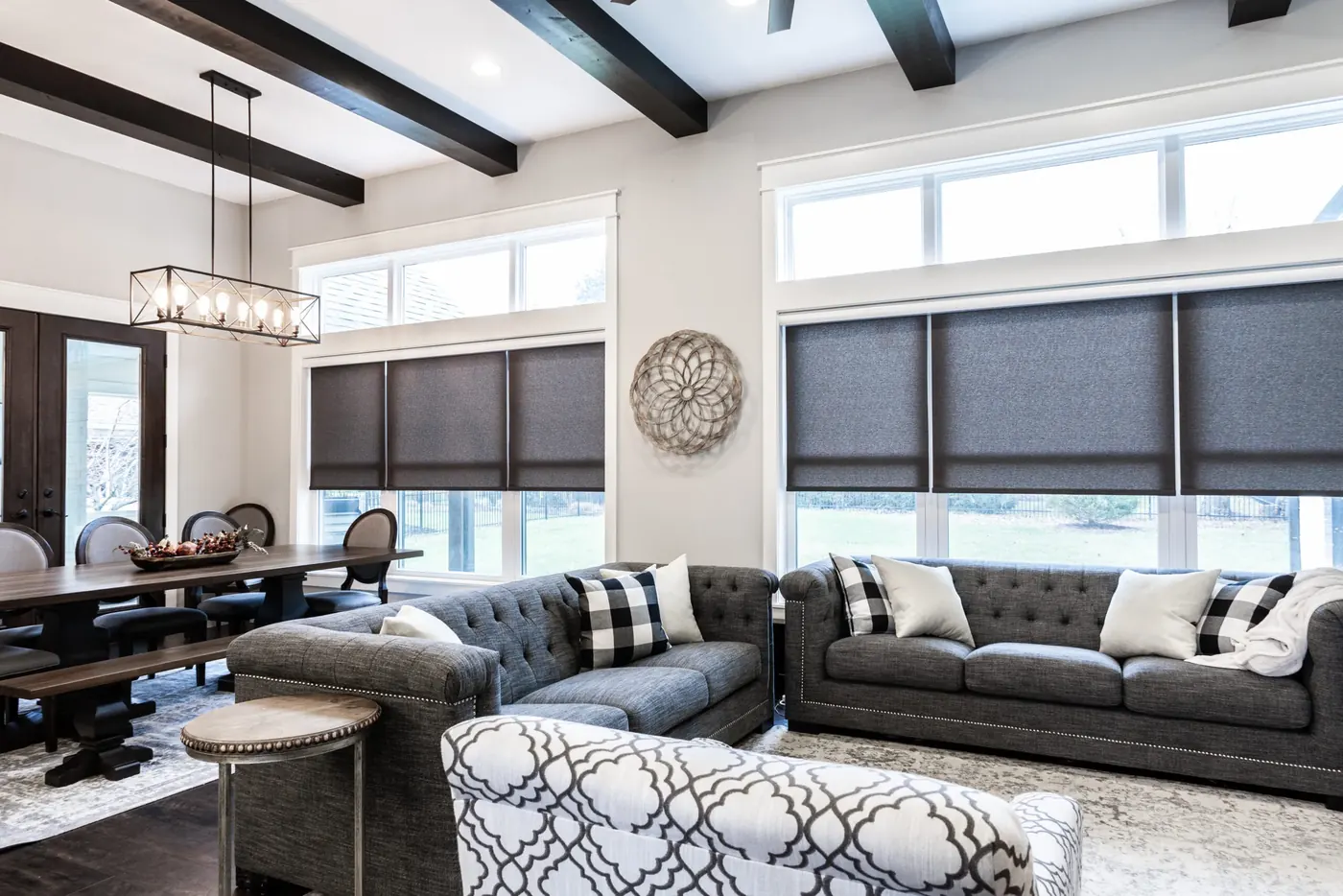
Photographs from real roller shades jobs completed by our crew in Lawrence and surrounding areas.
What Roller Shades Includes
Every Lawrence job is documented item by item. Here is what the crew covers.
Roll direction decided at the measure, regular or reverse, and written onto the order in plain words
Cranks, locks and handles inside the opening noted, because a regular roll drops the fabric straight onto them
Fascia and reverse roll checked against the manufacturer's own rules, since Lutron doesn't offer that pairing
Three widths and three heights taken per opening, plus a corner-to-corner square check
Mounting depth measured for the tube and bracket, then measured again if a cassette or fascia is wanted
Tube diameter sized to the finished width and the fabric weight so a long roll doesn't sag mid-span
Fabric opacity settled in writing before ordering, light filtering against room darkening against blackout
Side channels and a light-blocking bottom pocket specified where a room has to go dark rather than dim
Light gap per side disclosed at the measure and repeated on the paperwork before the order goes in
Shades over 120 inches tall, or past a 4:1 height-to-width ratio, flagged for larger gaps up front
Factory deduction left with the manufacturer, which is typically 1/16 inch per side
Chain side set window by window so the control lands on the hand you'd naturally reach with
Chain tensioner fastened per the product instructions on every continuous cord loop shade
Cordless and motorized lifts priced where a hanging chain doesn't belong in the room
Hembar chosen against the fabric weight, exposed aluminum or wrapped in the shade fabric
Coupled shades drawn across wide openings so two tubes turn together on a single line
Bracket substrate confirmed ahead of install day so the right anchor or trim screw goes in
Every shade run full travel twice on install day to prove the fabric tracks centered without telescoping
What Roller Shades Cost in Lawrence
National category numbers put stock shades near $60 to $600 a window and custom-fabricated shades roughly $250 to $2,600. Those are national ranges for the category and they aren't a quote for anything in Lawrence. Rollers spread across most of that band, because a roller is really a fabric decision wearing some hardware. A basic light filtering fabric on an open roll with a chain sits low. A blackout fabric in a cassette with side channels and a wrapped hembar sits far higher, and it should, since you're buying a light seal rather than a shade. Motorization is its own line, nationally $300 to $1,500 per window installed. Lawrence Window Treatments prices from measured openings across Marion County.
How Roller Shades Differ by Product
Every product in this trade behaves differently in a room. Here is what that means for this work.
Open roll: The tube and brackets left exposed above the window. It's the least expensive hardware and the most honest looking on a modern opening, though you do see the roll of fabric and the bracket ends from below and from the side.
Fascia: A flat aluminum face that runs across the front of the tube and hides the roll. It gives you a clean horizontal line above the window and it's usually wrapped or powder-coated. Note that reverse roll and fascia don't pair on Lutron systems.
Cassette headbox: A closed box around the tube, open only at the bottom where the fabric comes out. It hides the roll from every angle, keeps dust off the top of the roll, and gives a blackout install somewhere to tuck the top light gap.
Regular roll: Fabric comes off the back of the tube, so it hangs close to the glass. It's the default, it looks tidiest, and it's the roll direction that will foul a crank, a lock or a handle sitting inside the opening if nobody checked.
Reverse roll: Fabric comes off the front of the tube, standing off the glass by an inch or so. Specify it when there's hardware in the opening the fabric has to clear, or when a deep sill would otherwise catch the bottom of the shade.
Light filtering fabric: A woven or vinyl face that passes diffused daylight without a view through it. Rooms stay bright and glare goes soft. It's the everyday specification for a kitchen, a family room or anywhere darkness isn't what you're buying.
Room darkening fabric: A denser fabric that cuts most of the light coming through the face. Bedrooms are the obvious use. Understand that the face is doing the work and the edges are not, so an inside mount still passes light down both sides.
Blackout fabric with side channels: An opaque fabric run inside aluminum channels at each side so the edge light has nowhere to go. Paired with a cassette above and a pocket at the bottom, this is what actually makes a room dark rather than merely dim.
Continuous cord loop with a clutch: A bead chain running over a clutch in the end of the tube, which is the standard manual control. It handles weight well on tall shades. The tensioner has to be fastened to the wall or frame, not left hanging.
Dual bracket: One bracket carrying two tubes at the same window, so a solar screen and a blackout can live together and be used at different hours. It needs mounting depth, which is why we measure for it rather than deciding later.
See What Each Fabric Does To The Light
Pick a fabric below and the window updates. It's a drawing rather than a photograph, so read it as a rough guide to what each family does in a Lawrence room, and to what it doesn't do.
Openness factor is a measured fabric spec, so you can compare it line to line. The category names are not measured. One maker's room darkening can behave like another maker's light filtering, which is why the sample books come to the measure and get opened in the room they're going in, at the hour that room has the problem.
Roller Shades FAQ
Questions we hear most often from Lawrence homeowners considering roller shades.
Roller Shades Across Lawrence
We measure and install in every one of these Lawrence neighborhoods. Each has its own page with the build eras, window conditions and mounting notes for that section.
- Roller Shades in Fort Benjamin Harrison Historic District and Lawton Loop
- Roller Shades in Lawrence Village at the Fort
- Roller Shades in Greentree at Fort Harrison
- Roller Shades in Harrison Ridge and Harrison Run
- Roller Shades in Harrison Park and Harrison by the Park
- Roller Shades in Oaklandon
- Roller Shades in Indian Lake
- Roller Shades in Geist's Edge
- Roller Shades in Lanesville
- Roller Shades in Lawrence Park, Lawrence Terrace and Lawrence Manor
- Roller Shades in North Lawrence Park
- Roller Shades in The Roses of Lawrence
- Roller Shades in Lawrence Lakes and Lawrence Woods
- Roller Shades in Winding Creek and Winding Wood
- Roller Shades in Traditions and Peach Tree Cove
Other Window Treatment Services in Lawrence
Lawrence Window Treatments handles the full scope of window treatment work. Explore our other services below.
Schedule Your Free In-Home Measure in Lawrence
Reach Us Directly
Our team prioritizes scheduled measures and service calls, and books in-home measures during business hours.
Ready to Book Your Measure?
Call us to set up an in-home measure, or to ask about a treatment that has stopped working. We will talk it through on the phone first.